 English




LED strip lighting has become one of the most versatile and widely adopted solutions for modern residential, commercial, and architectural lighting. Among the different types of LED strips available today, SMD LED strip lights and COB LED strips are the two most popular choices. Each offers unique advantages, performance characteristics, and visual effects, making them suitable for different applications.
SMD stands for Surface-Mounted Diode. In SMD LED strip lights, tiny LED chips are mounted directly onto a flexible printed circuit board (PCB). These strips typically feature LEDs spaced at regular intervals and may have 30, 60, 120, or even 240 LEDs per meter depending on the model.
SMD LED strip lights are currently the most commonly used LED strips in the market due to their versatility, affordability, and wide range of chip options.
SMD LED strip lights use different chip sizes, with the most popular including:
SMD 3528 – Small, low power, soft accent lighting
SMD 2835 – Energy-efficient, high brightness for general lighting
SMD 5050 – Larger chip, multi-color RGB capability
SMD 5630/5730 – Very bright chips for high-output illumination
The numbers refer to chip dimensions in millimeters. For example, SMD 5050 is 5.0 mm × 5.0 mm.
Each chip type differs in brightness, efficiency, beam angle, and application suitability.
SMD LED strips have earned their popularity for several reasons:
Wide range of brightness levels
Available in single-color, tunable white, RGB, and RGBIC
Flexible and easy to install
Cost-effective and widely available
Compatible with various aluminum profiles and controllers
Because of these advantages, SMD LED strips are commonly used in homes, stores, hotels, signage, vehicles, display lighting, and more.
Although versatile, SMD LED strips have certain drawbacks:
Visible “dotting” when installed without a diffuser
Lower uniformity compared to COB
Potential heat buildup on high-density models
More complex structure (LEDs + resistors), increasing failure points
These limitations often lead designers to choose COB strips for projects that require flawless linear light.
COB, or Chip on Board, is an advanced LED packaging technology in which dozens or even hundreds of tiny LED chips are directly mounted onto the PCB and then encapsulated with a uniform layer of phosphor. Unlike traditional SMD LED strip lights—which use individual LED packages spaced at intervals—COB LED strips integrate the chips densely and seamlessly.
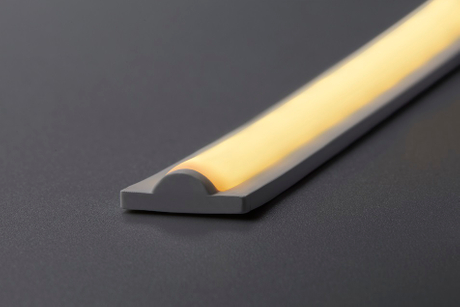
This manufacturing approach produces a continuous, dot-free line of light, often described as a “luminous ribbon.” Most COB LED strips feature 300–700 LEDs per meter, significantly higher than typical SMD strips with 60–120 LEDs per meter.
The result is exceptionally smooth illumination without the spotting effect commonly seen in SMD strips, especially when the lighting source is visible or reflected on glossy surfaces. This makes COB strips ideal for premium lighting applications where visual uniformity is essential.
COB LED strip lights have rapidly grown in popularity because they offer several standout benefits:
Completely uniform, dotless light output
The extremely high LED density combined with phosphor coating eliminates visible hotspots, producing an uninterrupted beam of light that is easy on the eyes and aesthetically superior.
Continuous luminous surface ideal for linear lighting
COB technology is excellent for creating modern linear lighting effects in ceilings, cabinets, shelves, and architectural details. Designers often favor them for minimalistic or futuristic interiors.
High flexibility and bendability
Because the chips are small and closely packed, COB strips can bend around corners and curved surfaces more smoothly than SMD strips. This makes them suitable for creative installations or tight spaces.
Excellent color consistency
The phosphor coating ensures uniform color temperature across the entire strip, reducing variations that can appear in SMD LED strips when chips come from different batches.
Soft, diffused lighting without a diffuser
COB strips naturally produce soft illumination, ideal for ambient lighting, under-cabinet lighting, cove lighting, and decorative lighting without requiring deep aluminum profiles or diffusers.
These advantages make COB LED strips especially appealing in high-end residential projects, commercial interiors, hotels, galleries, and modern architectural lighting.
Despite their excellent performance, COB LED strips also come with several limitations that need to be considered:
Slightly higher cost
The advanced manufacturing process and high LED density increase production costs, making COB strips more expensive than entry-level SMD options.
Lower brightness compared to high-output SMD models
While COB offers excellent uniformity, SMD chips—especially 5050, 5730, or high-power 2835—can achieve significantly higher lumen output. For applications that require extremely bright task lighting, SMD strips may be more suitable.
More delicate structure
The thin phosphor layer and densely packed chips make COB strips more vulnerable to damage from excessive bending, twisting, or rough handling. Proper installation is essential.
Limited RGB or color-changing options
Although RGB COB technology is emerging, most COB LED strips currently focus on single-color or tunable white designs. SMD strips remain the dominant choice for RGB, RGBW, and dynamic lighting effects.
Because COB strips emphasize visual quality, uniformity, and softness, they are best suited for ambient or decorative lighting, while SMD strips remain preferable for projects requiring exceptionally bright illumination or advanced color effects.
To choose the right strip for your project, it's important to compare the two technologies side by side.
SMD Strips:
Show individual LED dots unless used with a deep diffuser.
COB Strips:
Produce smooth, dot-free continuous light—excellent for visible installations.
SMD: Generally brighter, especially when using 5050 or 5730 chips.
COB: High LED density but softer illumination due to phosphor coating.
For tasks requiring maximum brightness, SMD LED strip lights are usually preferred.
SMD:
Available in single color, warm/cool white, RGB, RGBW, and addressable versions.
COB:
Mostly available in single color or CCT tunable white.
RGB COB strips exist but are less common and more expensive.
COB strips are more flexible because their LED chips are extremely small and evenly distributed.
SMD strips may not bend smoothly around curved surfaces.
SMD Strips:
Larger chips generate more heat, requiring good aluminum profiles.
COB Strips:
Smaller chips distribute heat more evenly but can be more fragile during installation.
Both are highly efficient, but COB strips often perform better in lumen-per-watt when designed for soft lighting.
SMD strips: Usually cheaper and widely available.
COB strips: Slightly more expensive due to advanced manufacturing.
Because of their brightness and versatility, SMD LED strips are ideal for:
Cabinet lighting
Architectural accents
RGB and decorative color lighting
Outdoor lighting (IP65/IP67 models)
Retail and display illumination
Vehicle or boat lighting
Signage and advertising panels
Task lighting
High-output SMD strips are especially good for workspaces and large rooms.
COB LED strips shine in applications requiring perfectly uniform illumination:
Linear lighting in hotels or homes
Minimalist interior design
Cove lighting
Under-cabinet lighting without aluminum profiles
Backlighting for furniture or displays
Mirror or vanity lighting
Bookshelf lighting
Any visible installation with no diffuser
Designers often choose COB strips when the lighting source will be visible and esthetics matter.
Whether you choose SMD or COB LED strip lights, it is important to evaluate several factors.
For comfortable indoor lighting, pay attention to:
Color temperature (2700K warm white to 6500K daylight)
CRI (Color Rendering Index) – CRI 90+ provides more natural color appearance
High-CRI COB and SMD strips are preferred for homes, studios, and retail environments.
LED strips come in:
12V – For short runs, flexible applications
24V – Better for long runs with lower voltage drop
48V – For professional installations and large spaces
Long installations benefit most from 24V or 48V options.
Outdoor or kitchen applications may require:
IP20 – Indoor dry areas
IP54 – Dust/splash-resistant
IP65/IP67/IP68 – Waterproof for outdoor or wet environments
Higher LED density means smoother lighting:
SMD strips: 60–120 LEDs per meter
COB strips: 300–700 LEDs per meter
Choose the density based on desired brightness and lighting uniformity.
Make sure your:
Power supply matches the strip voltage
Wattage is 20–30% higher than total LED load
Controller supports dimming or RGB functions if needed
Both COB and SMD LED strip lights have unique strengths, and the right choice depends on your lighting goals. If you want intense brightness and vibrant colors, SMD strips are the more versatile and powerful option. If you prefer smooth, elegant, and continuous lighting without visible dots, COB strips deliver exceptional visual quality.
If you're exploring lighting solutions for a home renovation, retail project, architectural installation, or commercial space, partnering with an experienced lighting manufacturer can help you make the best decision.
To learn more about high-quality COB and SMD LED strip lighting—or to get expert recommendations for your project—you may visit ORIENT LIGHTING Co., Ltd., where you can explore professional-grade LED solutions that meet modern design and performance needs.