Views: 0 Author: Site Editor Publish Time: 2025-11-21 Origin: Site
Flexible SMD LED strip lights have become one of the most popular lighting solutions in both residential and commercial environments. Their slim profile, low power consumption, and versatility make them suitable for accent lighting, task lighting, decorative installations, and even large-scale architectural illumination. Among the wide range of LED chips available today, SMD 3528 and SMD 5050 remain two of the most commonly used and widely recognized options.
Understanding the differences between these two LED types is essential for making the right choice for your lighting project. While both belong to the family of Surface-Mounted Device (SMD) LEDs, each type offers unique characteristics in brightness, efficiency, color mixing, and application suitability.
This article provides a comprehensive comparison of SMD 3528 vs. SMD 5050 flexible LED strip lights, explaining their structures, performance, benefits, and recommended use cases. By the end of this guide, you will have a clear understanding of which LED strip is ideal for your lighting needs.
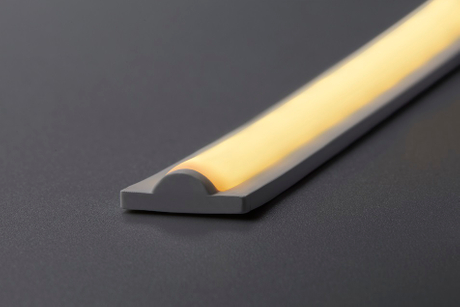
SMD LED strip lights consist of a flexible printed circuit board (FPCB) populated with LED chips using SMD packaging technology. These strips are easy to mount, bend, and cut into customized lengths, making them an ideal option for spaces where traditional lighting fixtures cannot be installed.
Key advantages include:
Flexibility: Easily adapts to curved surfaces or tight spaces
Low energy consumption: Efficient LEDs for long-term use
Variety in brightness & colors: Multiple chip sizes and color temperature options
Easy installation: Adhesive backing and low-voltage operation
Among the various SMD chip types, the 3528 and 5050 formats have become industry standards due to their balance of performance, cost, and compatibility.
The designation 3528 refers to the physical dimensions of the LED chip, which measures 3.5 mm × 2.8 mm. This compact footprint makes 3528 LEDs one of the earliest and most widely used LED formats in light-strip manufacturing. Their small size allows manufacturers to pack many diodes closely together on a strip, supporting flexible design and delivering smooth, continuous illumination without visible gaps. Although they are not the brightest chips on the market, their efficiency and versatility make them ideal for a wide range of low-to-medium brightness lighting applications.
SMD 3528 LEDs typically produce 6–8 lumens per LED, consuming only around 0.06 watts per diode. This combination of modest brightness and exceptionally low energy use allows these strips to deliver soft illumination while keeping power consumption minimal. Depending on the model, light strips may use 60, 120, or 240 LEDs per meter. Higher-density versions produce more uniform brightness and are suitable for larger areas that require consistent lighting. Because of their balanced efficiency, 3528 strips are a popular choice for users who want comfortable lighting that does not overpower a room.
SMD 3528 LED strips come in a variety of color temperatures and single-color options, including warm white, cool white, daylight, and a full spectrum of single-color options such as red, green, blue, amber, and more. Unlike larger multi-chip designs like SMD 5050 or SMD 2835 RGB LEDs, the 3528 format typically contains only one light-emitting diode per chip, meaning it cannot change colors. This makes them ideal for static, consistent lighting projects.
Due to their compact size and gentle brightness, SMD 3528 LEDs are commonly used in under-cabinet lighting, cove lighting, bedroom ambiance, decorative home accents, retail shelf lighting, and even automotive interior illumination. Their soft glow creates a relaxing atmosphere, making them perfect for accent and mood lighting rather than tasks requiring intense brightness.
The 5050 chip measures:
5.0 mm × 5.0 mm
This larger footprint allows the chip to hold three diodes inside—meaning one 5050 LED can produce more light than a 3528 LED and support multicolor functionality.
5050 LEDs typically produce:
20–22 lumens per LED
Higher power consumption (about 0.2 watts per LED)
A 5050 strip with high LED density (e.g., 60 or 120 LEDs per meter) is significantly brighter than a 3528 strip and suitable for primary lighting in some environments.
Unlike 3528 LEDs, SMD 5050 chips can integrate red, green, and blue diodes in a single package. This allows:
Smooth color mixing
Dynamic color-changing lighting
RGBW versions for better white light quality
This makes 5050 strips the preferred choice for creative or atmospheric lighting projects.
Feature wall illumination
Outdoor signage
Backlighting for TV or gaming setups
Bars, clubs, and hospitality lighting
Event and stage lighting
High-brightness work areas
5050 strips are ideal when brightness and dynamic colors are essential.
To help visualize the comparison, here is an overview of the main differences:
Feature | SMD 3528 | SMD 5050 |
Chip Size | 3.5 × 2.8 mm | 5.0 × 5.0 mm |
Light Output | Low–medium | High |
Lumens per LED | 6–8 lm | 20–22 lm |
Power Consumption | 0.06 W per LED | 0.2 W per LED |
RGB Options | No | Yes |
Heat Generation | Low | Moderate |
Ideal Use | Ambient / accent | Highlighting / RGB lighting |
Applications | Home decor, cove, cabinet | Stage lights, signage, feature walls |
Soft ambient illumination
Energy-efficient, long-lasting lighting
A cost-effective solution
Subtle decorative effects
Under-cabinet or cove lighting
Lighting in confined spaces
3528 strips offer understated brilliance and minimal heat—ideal for smaller or decorative installations.
Bright, attention-grabbing lighting
RGB color-changing effects
Lighting that doubles as visual décor
Higher lumen output
Stronger illumination for larger spaces
5050 strips are powerful, colorful, and ideal for creative or high-impact lighting designs.
Both 3528 and 5050 strip lights are available in:
5V
12V
24V
12V is common for home and vehicle use, while 24V is preferred for long runs to minimize voltage drop.
A strip's brightness depends not only on LED type but also on LED density. Common densities include:
60 LEDs/meter
120 LEDs/meter
240 LEDs/meter (high-density strips)
Higher-density strips produce more uniform illumination and eliminate dark spots, especially for task lighting.
While SMD 3528 produces minimal heat, 5050 strips generate more due to higher power. For long installations, using:
Aluminum channels
Heat-dissipating profiles
helps extend the lifespan of LED chips.
For installations exposed to moisture or outdoor conditions, both types offer IP65, IP67, and IP68 waterproof ratings.
IP65: Suitable for indoor moisture (kitchen, bathroom)
IP67: Submersible up to 1 meter for short periods
IP68: Continuous underwater operation
Waterproof 5050 strips are commonly used in outdoor signage and landscape lighting, while 3528 waterproof strips are popular for patios, staircases, and accent illumination.
Both LED types offer excellent energy efficiency. Typical lifespan:
SMD 3528: 30,000–50,000 hours
SMD 5050: 25,000–35,000 hours
Because 5050 LEDs produce more heat, their lifespan can be reduced if not installed properly with heat dissipation.
Still, both options are far more energy-efficient and durable compared to incandescent or halogen lighting.
SMD 3528 strips are generally more affordable due to:
Smaller chip size
Lower power consumption
Simpler production processes
SMD 5050 strips, especially RGB or RGBW versions, cost more due to:
Higher brightness
More diodes per chip
More complex control systems
When choosing between the two, consider both initial investment and long-term operating costs.
3528: kitchen counters, bookcases, closets
5050: living room accent walls, gaming setups, home theaters
3528: display shelves, product highlights
5050: signage, color-changing atmospheres, event halls
3528: pathway guides, garden edging
5050: architectural outlines, building facades, fountains
There is no single "best" choice—only the best choice for your specific needs.
Choose SMD 3528 if you prefer:
Subtle light
Lower cost
Energy efficiency
Minimal heat
Long service life
Choose SMD 5050 if you want:
High brightness
Vibrant RGB effects
Strong visual impact
Versatile color control
Evaluating the location, purpose, and desired brightness level will guide you toward the right solution.
Flexible SMD LED strip lights continue to revolutionize modern lighting with their versatility, efficiency, and design freedom. Whether you choose SMD 3528 for soft ambient lighting or SMD 5050 for high-impact and RGB applications, both options offer reliable performance across a wide range of environments.
If you're exploring high-quality SMD LED strip lights for your lighting projects, ORIENT LIGHTING Co., Ltd. provides a wide selection of reliable and well-engineered solutions. Their products cover various SMD types, lengths, brightness options, and customization capabilities. For more detailed product specifications or professional guidance, you can visit ORIENT LIGHTING Co., Ltd. to learn more or contact their team for expert support.