 English


Views: 0 Author: Site Editor Publish Time: 2026-04-14 Origin: Site


High-end kitchen countertops demand immediate attention. You spend thousands on premium marble, quartz, or granite to elevate your home's interior design. Yet, these beautiful materials quickly lose their visual impact if illuminated by incorrect color temperatures. This creates a frustrating and common core challenge for homeowners and designers alike. Mismatched lighting causes severe color distortion across different surface finishes. It can make crisp white quartz look muddy and noticeably yellowed overnight. Conversely, the wrong light easily turns a warm, inviting butcher block into a sterile, gray slab.
We created this comprehensive guide to help you prevent these expensive aesthetic mistakes. You will discover a clear decision-stage framework to perfectly match Correlated Color Temperature (CCT) to your specific countertop materials. Furthermore, we will walk you through essential hardware evaluation criteria for under-cabinet lighting. By the end of this guide, you will know exactly how to specify and position your fixtures to ensure a flawless, professional-grade kitchen installation.
Countertop undertones dictate CCT: Match warm materials (wood, beige granite) with 2700K–3000K, and cool materials (white marble, concrete) with 4000K.
CRI is a non-negotiable metric: Even with the correct CCT, a Color Rendering Index (CRI) below 90 will dull the natural veining and aggregate in stone surfaces.
Surface reflectivity requires diffusion: Glossy countertops reflect exposed diodes; high-density strips and diffused channels are required to prevent harsh glare.
Testing mitigates risk: Utilizing a tunable LED strip light during the mockup phase is the most reliable way to finalize permanent CCT selection.
Correlated Color Temperature (CCT) measures the color appearance of light. We express this measurement in Kelvin (K). In residential kitchen environments, we typically work within three standard lighting ranges. Warm White falls between 2700K and 3000K. Neutral White spans from 3500K to 4000K. Daylight temperatures start at 5000K and go higher. Lower Kelvin numbers produce a cozy, amber glow. Higher Kelvin numbers emit a crisp, bluish-white light.
Many people mistakenly rely on CCT alone to evaluate lighting quality. This is a common mistake. CCT only tells you the color of the light itself. It does not measure how accurately that light reveals the true colors of objects beneath it. We use the Color Rendering Index (CRI) to measure color accuracy on a scale from 0 to 100.
You need a CRI above 90 to accurately reflect true colors. Ideally, you should target a CRI greater than 95. If you use an 80 CRI fixture, red tomatoes will look dull and unappetizing. Similarly, the rich natural minerals in your stone countertops will appear flat. High-CRI lighting ensures vibrant food prep and brings out the subtle gold or gray veining in luxury stone.
Your kitchen does not exist in a vacuum. Natural daylight from kitchen windows constantly shifts the perceived CCT throughout the day. Morning sunlight feels warm, while midday sun introduces harsh, cool light. You must coordinate your under-cabinet task lighting with your overhead ambient lighting.
If your ceiling recessed lights are 3000K, installing 5000K under-cabinet lights creates severe color clashing. The space will feel visually disjointed. We strongly recommend keeping your under-cabinet CCT within 500K of your primary ambient lighting to maintain harmony.
Selecting the right CCT requires you to identify the primary undertones in your countertop material. Below is a detailed breakdown of how to pair specific materials with their ideal Kelvin range.
When working with natural wood grains or earthy stone aggregates, you should target a CCT of 2700K or 3000K. Warm light beautifully enhances the red, orange, and brown undertones found in butcher block and beige granite. It creates a welcoming, intimate atmosphere. Using a cool 4000K light on warm wood washes out the rich grain, leaving it looking dull and artificially aged.
White quartz and light gray surfaces require careful consideration. Target a CCT between 3500K and 4000K. This neutral range prevents bright white surfaces from looking dingy or yellowed. It maintains a clean, sanitary appearance. At the same time, it stops short of feeling overly clinical or harsh. A 4000K light source makes the crisp white background of a quartz slab look brilliant and pure.
Industrial materials and cool-toned stones pair best with a target CCT of 4000K to 5000K. Carrara marble features distinct blue and gray veining. A 4000K light perfectly complements these cool undertones. Similarly, concrete and stainless steel benefit from this cooler light. It highlights their stark, modern finishes and enhances the architectural feel of a contemporary kitchen.
Dark surfaces present a unique lighting challenge. Your target CCT should be 3000K or 4000K, depending heavily on your upper cabinet color. Dark stone absorbs significant amounts of light. Therefore, higher lumen output becomes strictly required regardless of your chosen color temperature. If your cabinets are dark wood, stick to 3000K to maintain warmth. If your cabinets are stark white above a black countertop, 4000K provides excellent high-contrast illumination.
Countertop Material | Undertone Profile | Optimal CCT Range | Visual Effect |
|---|---|---|---|
Butcher Block / Walnut | Warm (Reds, Browns) | 2700K - 3000K | Enhances natural wood grain and warmth. |
White Quartz / Calacatta | Neutral (Pure White, Gold) | 3500K - 4000K | Keeps white base crisp; prevents yellowing. |
Carrara Marble / Concrete | Cool (Blues, Grays) | 4000K - 5000K | Pops cool veining; highlights modern textures. |
Black Soapstone | Dark (Black, Charcoal) | 3000K or 4000K | Absorbs light; requires higher lumen output. |
Finding the perfect color temperature is only half the battle. You must also evaluate the physical hardware of your LED strip light to ensure it meets the functional demands of a kitchen workspace.
You must evaluate brightness based on the light's intended purpose. Are you installing functional task lighting for chopping vegetables, or ambient accent lighting for evening mood? For safe and effective food preparation, you should target an output of 300 to 500 lumens per foot. Anything lower than 300 lumens forces you to strain your eyes while reading recipes or handling kitchen knives.
Diode density refers to how closely packed the individual LED chips are on the circuit board. You must choose between low-density and high-density options. Standard strips featuring only 30 LEDs per meter fail miserably in under-cabinet applications. They space the diodes too far apart. This causes terrible "spotting" or pooling of light on your counters.
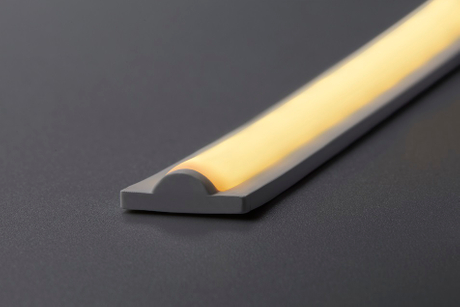
To fix this, we strongly recommend COB (Chip on Board) technology. COB strips pack hundreds of tiny diodes together and cover them in a continuous phosphor layer. This creates a completely seamless, dot-free line of illumination. It acts like a solid bar of light rather than individual bulbs.
Most professional installers consider 24V the absolute standard for kitchen runs. When you run a long line of lighting across multiple cabinets, the electrical voltage slowly drops toward the end of the wire. A 12V system suffers from severe voltage drop. This causes the lights at the end of your counter to appear noticeably dimmer than the lights near the power supply. Using a 24V system minimizes this voltage drop, ensuring perfectly even brightness across long spans of cabinetry.
Highly polished marble and quartz surfaces act exactly like mirrors. If you mount bare diodes underneath your cabinets, the glossy countertop will reflect the ugly underside of the hardware. This creates a severe "dot effect" across your kitchen workspace.
You can solve this by utilizing specific mounting hardware. The mandatory best practice is using aluminum extrusions paired with milky or frosted polycarbonate diffusers. The diffuser lens scatters the harsh light before it hits the glossy stone. This transforms sharp glare into a soft, luxurious wash of illumination.
Where you place the light changes everything. You essentially have two choices: front-mounting near the cabinet lip, or rear-mounting near the backsplash. Rear-mounting washes the backsplash with light but leaves the front half of your countertop shadowed. This makes food prep difficult.
Instead, install your LED flexible strip near the front lip of the upper cabinet. If possible, use a 45-degree angled aluminum channel. Front-mounting angled toward the backsplash minimizes direct eye glare. It also pushes the maximum amount of functional task lighting directly onto the center of your cutting boards.
LEDs generate heat. Installing a strip directly onto wooden cabinets without proper thermal management creates a major risk. Wood acts as an insulator, trapping the heat around the diodes. This trapped heat drastically reduces the lifespan of the fixture. It causes the colors to shift and the diodes to burn out prematurely.
Always place your lights inside an aluminum channel. The aluminum acts as a highly efficient heat sink. It draws thermal energy away from the diodes and dissipates it safely into the air, guaranteeing years of reliable performance.
Procuring your lighting requires a methodical approach. Do not guess your final specifications. Follow these concrete steps to ensure your project succeeds.
Never commit to a static single-color strip without performing on-site testing first. Paint colors, cabinet stains, and natural window light all alter how a countertop looks.
Purchase a sample: Buy a short tunable white (CCT-adjustable) strip.
Tape it up: Temporarily tape the strip under your cabinets using painter's tape.
Test the shifts: Cycle through 2700K, 3000K, and 4000K settings.
Check different times: Observe the countertop at night and during peak daylight hours.
This mockup phase eliminates guesswork. It allows you to lock in the absolute best color temperature for your specific environment.
Your lighting system requires a dedicated power supply, often called a driver. You must calculate the total required wattage accurately. Multiply your strip's wattage per foot by the total feet of lighting you plan to install. Then, add a mandatory 20% headroom margin. For example, if your lights consume 50 watts, you need at least a 60-watt driver. This prevents the driver from overheating.
Additionally, select dimmable drivers (such as Triac or 0-10V formats). These integrate seamlessly with standard residential wall switches. Dimming gives you the power to adjust light intensity after you lock in the perfect CCT.
Before pulling out your credit card, review this technical checklist:
Confirmed CCT: Matches your mockup phase results perfectly.
Color Accuracy: Certified >90 CRI (or >95 CRI for premium spaces).
System Voltage: 24V system chosen to prevent voltage drop across cabinets.
Power Supply: Wattage calculated with 20% headroom and compatible dimming protocols.
Thermal Management: Aluminum channels with frosted diffusers included.
Accessories: Necessary jumper cables acquired for bridging gaps over sinks or stoves.
Choosing the right lighting transforms an ordinary kitchen into a stunning architectural space. Your countertop materials dictate the baseline CCT you must select. Warm woods need warm lighting, while cool stones demand crisp, neutral lighting. Furthermore, your surface finish—whether glossy or matte—dictates the required hardware, forcing you to utilize proper density and diffusion to eliminate glare.
To guarantee success, follow these final action steps. First, default to 3000K for warm, traditional kitchens and 4000K for white, modern environments. Second, never guess your lighting; always test tunable samples directly against your installed stone. Finally, strictly validate your hardware choices, ensuring you utilize high-CRI, deeply diffused solutions. Taking these deliberate steps thoroughly protects the visual integrity of your countertop investment.
A: While 5000K highlights the crisp white and cool veining of marble, it can often feel too sterile or "blue" for residential kitchens. 4000K is generally the safest choice for balancing modern aesthetics with a welcoming environment.
A: It is a lighting strip that contains alternating warm and cool diodes, allowing you to manually adjust the color temperature via a controller (e.g., from 2700K up to 6000K) to perfectly match your countertop after installation.
A: Polished quartz is highly reflective. This happens when the diode density is too low or the strip is exposed. Upgrading to a COB strip or installing a deep aluminum channel with a frosted diffuser will eliminate the dots.
A: Yes. Dark wood cabinets absorb light and pair best with warmer CCTs (2700K-3000K), while white or brightly painted cabinets reflect light and can easily accommodate cooler, neutral temperatures (3500K-4000K).