Views: 0 Author: Site Editor Publish Time: 2025-11-07 Origin: Site
LED lighting has revolutionized the way homes, commercial spaces, and decorative environments are illuminated. Among the most popular modern lighting solutions, LED flexible strip lights stand out because they combine versatility, energy efficiency, and sleek aesthetics. Within this category, SMD LED strip lights have become the industry standard due to their compact size, strong brightness, and adaptability to a wide range of applications.
As the demand for flexible lighting solutions increases, buyers often face the challenge of choosing the right type of LED strip. Should you choose SMD strips or COB strips? Are higher density strips always better? What chip size matters most?
SMD (Surface-Mounted Device) LED strip lights are flexible circuits embedded with small LED chips soldered directly onto the surface of the strip. Each LED chip contains semiconductor material that converts electricity into visible light. Because the chips are mounted directly on the strip's surface, SMD LEDs offer strong brightness, efficient heat dissipation, and a thin, lightweight structure.
The most commonly used SMD chip sizes include:
SMD 3528 – Small and energy-efficient, ideal for accent lighting
SMD 5050 – Larger and brighter, capable of RGB color mixing
SMD 2835 – New-generation high-efficiency chips with improved heat management
SMD 5630 / 5730 – Ultra-bright chips often used in commercial environments
SMD LED strip lights are flexible, cuttable, and easy to install, making them suitable for architectural lighting, furniture illumination, backlighting, signage, vehicle decoration, and more.
Today's market offers several types of LED strip lights, each with its advantages. Understanding the differences can help you choose the right product for your application.
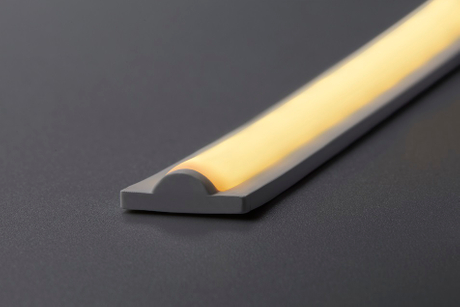
COB (Chip on Board) LED strips use a continuous phosphor coating over many tiny LED chips arranged closely together. This results in a uniform line of light with no visible hotspots.
Comparison:
Feature | SMD LED Strips | COB LED Strips |
Light Appearance | Visible individual LED dots | Continuous, dot-free illumination |
Brightness | High, depending on chip size and density | Moderately high but uniform |
Flexibility | High flexibility, suitable for angles and curves | Very high, even smoother bending |
Heat Dissipation | Good | Excellent |
Cost | Generally lower | Higher |
Conclusion:
Choose SMD if you want higher brightness, lower cost, or RGB color mixing.
Choose COB if you need ultra-smooth lighting without visible pixel points.
High-voltage LED strips (often AC 220V or 110V) are commonly used for outdoor or large-scale lighting because they can run longer lengths without voltage drop.
Comparison:
Feature | SMD Low Voltage Strips (DC 12/24V) | High-Voltage Strips |
Safety | Safer, low voltage | Higher electrical risk |
Brightness Control | Easy to dim | Harder to dim smoothly |
Suitability for Indoor Use | Excellent | Limited |
Installation Length | Usually up to 10–15 meters | Can run 50–100 meters |
Heat | Low | Higher |
Conclusion:
Choose SMD low-voltage strips for homes, cabinets, displays, and indoor architectural lighting.
Choose high-voltage strips for long outdoor installations such as building outlines or garden perimeters.
Neon flex strips are often used for signage and decorative lighting that requires smooth, uniform lines similar to traditional neon tubes.
Comparison:
Feature | SMD LED Strips | LED Neon Flex |
Light Output | Directional, bright | Even, diffused light |
Application | General lighting, task lighting | Decorative lines, artistic designs |
Cutting Flexibility | Very flexible | Less flexible (thicker material) |
Installation | Simple and adhesive-based | Requires clips or channels |
Conclusion:
Choose SMD for brightness and practicality.
Choose Neon Flex for decorative or signage lighting with soft, diffused lines.
Different SMD chips offer varying levels of efficiency, brightness, thermal performance, and color rendering. Understanding these differences helps users select the most suitable LED flexible strip light for residential, commercial, or decorative applications.
LED size: 3.5 mm × 2.8 mm
Light output: Soft, low-power illumination
Best for: Accent lighting, bedroom ambience, cove lighting, under-cabinet decoration
The SMD 3528 chip is one of the earliest and most widely used LED packages in flexible strips. Its compact design makes it ideal for applications that require subtle, comfortable lighting rather than high brightness. Although not as powerful as newer chips, it offers excellent stability and energy efficiency. Many homeowners use 3528 strips for mood lighting, such as behind TVs, inside shelves, or along ceiling borders, where too much brightness would be distracting.
LED size: 5.0 mm × 5.0 mm
Features: Three diode cores, allowing RGB or RGBW effects
Brightness: Higher than 3528
Best for: Gaming rooms, entertainment spaces, stage lighting, color-changing environments
The SMD 5050 chip is significantly larger and more powerful. Its tri-chip structure enables dynamic color mixing, making it the preferred choice for RGB or RGBW LED strips. These chips produce vivid color transitions and strong brightness, perfect for decorative installations where visual impact matters. Because they consume more power, 5050 strips are often paired with higher-capacity power supplies.
Generation: Newer, more efficient package
Brightness: Higher than 3528 with better lumen-per-watt output
Thermal performance: Improved heat dissipation for extended lifespan
Best for: Architectural lighting, under-cabinet task lighting, commercial interiors
The SMD 2835 chip is designed for maximum efficiency and stability. Despite its small size, it is capable of producing high brightness while maintaining low heat, making it suitable for long, continuous installations. Many modern high-density LED strips adopt 2835 chips due to their reliability and color uniformity. This makes them a go-to solution for designers seeking a balance between brightness and energy savings.
Brightness: Extremely high lumen output
Best for: Commercial lighting, workshop illumination, retail displays
Installation note: Often paired with aluminum channels for thermal management
SMD 5630 and 5730 chips deliver some of the highest brightness levels available in flexible strip lighting. Their larger footprint and strong light output make them ideal for task-oriented environments where clear visibility is important. Because these chips generate more heat, proper heat dissipation—usually through aluminum profiles—is essential to maintain longevity and prevent performance degradation. They are commonly used in supermarkets, workbenches, signage backlighting, and other high-brightness scenarios.
LED strip brightness is influenced by both chip type and LED density (LEDs per meter).
Typical densities include:
30 LEDs/m – accent lighting
60 LEDs/m – standard household use
120 LEDs/m – high brightness
240 LEDs/m – professional-grade, smooth illumination
Higher density strips provide:
More uniform light
Higher lumens
Reduced spotting when used behind diffusers
However, they also generate more heat and require stronger power supplies.
SMD LED strip lights are known for their excellent energy efficiency. Power usage typically ranges from:
4.8W per meter for low-density strips
9.6–14.4W per meter for medium-density strips
18–24W per meter for ultra-bright strips
Important considerations:
Choose the right wattage for your application to avoid excessive heat
Use the correct power supply (12V or 24V)
Select dimmable drivers if brightness adjustment is needed
24V systems provide better stability on longer runs and reduce voltage drop.
LED strips are available in a range of color temperatures:
Warm White (2700–3000K) – Cozy, relaxing
Neutral White (3500–4000K) – Balanced and natural
Cool White (5000–6500K) – Bright, energizing
Selecting the right temperature depends on the intended atmosphere and application.
High-quality SMD LED strips typically offer CRI 80–95, meaning they reproduce colors accurately.
CRI 90+ is recommended for retail stores, galleries, and residential areas where accurate color perception matters.
LED strips come with varying IP ratings that determine their resistance to dust and water:
IP20 – Indoor, dry locations
IP65 – Water-resistant silicone coating
IP67 – Fully sealed for outdoor use
IP68 – Submersible, suitable for fountains or pools
For long-lasting performance:
Use aluminum channels for heat dissipation
Choose UV-resistant coatings for outdoor installation
Ensure proper connectors and sealed ends
SMD LED strip lights are among the most adaptable lighting products available. They excel in:
Under-cabinet kitchen lights
Cove lighting in living rooms
Bedroom ambiance lighting
Stair illumination
Display shelves and showcases
Retail lighting
Restaurant decoration
Bar counters and architectural accents
Workbench lighting
Machinery edge lighting
Warehouse marking and safety illumination
Interior accent lights
Boat cabin lights
Exterior decorative strips (with waterproof protection)
Stage setups
Exhibition booths
Holiday decorations
LED flexible strip lights have become an essential lighting solution due to their versatility, efficiency, and ease of installation. Among the different types available, SMD LED strip lights offer an ideal balance of brightness, cost-effectiveness, and wide usability. Whether you're illuminating a home interior, enhancing a retail display, or designing a creative lighting project, SMD LED strips deliver strong performance with excellent customization options.
If you'd like to explore high-quality SMD LED strip lights with reliable performance, consistent color output, and options for every application, you may want to learn more from ORIENT LIGHTING Co., Ltd. They provide professional-grade LED strip lighting solutions and can assist you in selecting the most suitable products for your needs.